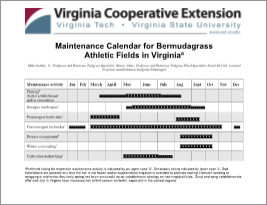
Maintenance Calendar for Bermudagrass
ID
SPES-329NP

a Preferred timing for respective maintenance activity is indicated by an uppercase ‘X’. Secondary timing indicated by lower case ‘x’. Sod installations are possible any time the soil is not frozen and/or supplemental irrigation is available to promote rooting. Dormant seeding or sprigging in mid-winter thru early spring has been successful as an establishment strategy on non-irrigated fields. Seed and sprig establishments after mid-July in Virginia have increased risk of first-season winterkill, especially in the coolest regions.
b Bermudagrass cultivars vary in establishment methods. Several cultivars do not produce viable seeds and can be established only by vegetative methods (sod, sprigs, or plugs).
c Fertilization with nitrogen applications of 0.7 lb. water-soluble N/1000 sq ft per active growing month is typical during preferred timing intervals. Rates of 0.25-0.5 lb N/1000 sq ft every 4 weeks are recommended for secondary timing intervals. Slowly available sources can be applied up to 1 lb N/10000 sq ft per active growing month. Other supplemental nutrients and/or lime should be applied based on soil test results. Fertilize overseeded fields after bermudagrass has entered dormancy and during periods of active ryegrass growth at levels up to 0.7 b N/1000 sq ft per active growing month for the ryegrass. Never apply fertilizer to frozen ground.
d Spring preemergent (PRE) herbicide applications are primarily targeting summer annual weeds such as crabgrass, goosegrass, or foxtails. Fall applications are primarily targeting annual bluegrass and winter annual broadleaf weeds such as henbit, deadnettle, chickweed, and geranium. Before applying any PRE herbicide, consider possible effects on the recuperation rate of heavily trafficked areas of the field that possibly would be re-seeded with bermudagrass or overseeded with ryegrass.
e Weeds must be actively growing to achieve desirable postemergent (POST) herbicide control. For cool-season weeds, active growth occurs when temperatures are ≥ 50o F. For warm-season weeds, temperatures ≥ 80o F are typically required for maximum control. If field is not overseeded, there is potential for winter weed control with non-selective POST herbicides during winter dormancy of the bermudagrass. Consult the Virginia Cooperative Extension Pest Management Guide or other publications for recommendations on chemicals, their rates, and timing of application.
f The primary disease of concern is spring dead spot, a disease where infection of the root system occurs in the fall. If a bermudagrass sports field has a history of spring dead spot, the disease can be managed by making sequential fungicide applications on 4-6 week intervals, with the first application occurring in early to mid-September. Consult the Virginia Cooperative Extension Pest Management Guide or other publications for recommendations on chemicals, their rates, and timing of application.
g Perennial, annual or intermediate ryegrass at rates of 5-10 pounds of pure live seed/1000 sq ft are recommended for situations warranting winter overseeding for playability, color, and/or overall aesthetics. To maximize bermudagrass performance the following year, it is recommended that the ryegrass overseeding be chemically or culturally removed as soon as spring sports are completed.
h Aggressive cultivation programs (hollow tine coring, vertical mowing, fraze mowing etc.) should only be done when the turf has complete regrowth potential based on anticipated weather conditions and field use scheduling. Less invasive cultivation methods such as slicing, spiking, or solid-tine aeration can be used at a greater frequency with minimal concerns about turfgrass recovery potential.
Virginia Cooperative Extension materials are available for public use, reprint, or citation without further permission, provided the use includes credit to the author and to Virginia Cooperative Extension, Virginia Tech, and Virginia State University.
Virginia Cooperative Extension is a partnership of Virginia Tech, Virginia State University, the U.S. Department of Agriculture (USDA), and local governments, and is an equal opportunity employer. For the full non-discrimination statement, please visit ext.vt.edu/accessibility.
Publication Date
November 9, 2026