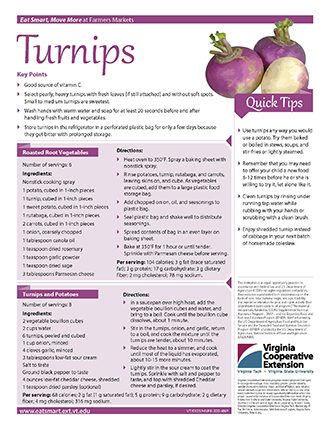
Eat Smart, Move More at Farmers Markets: Turnips
ID
HNFE-320-4NP
Key Points
- Good source of vitamin C.
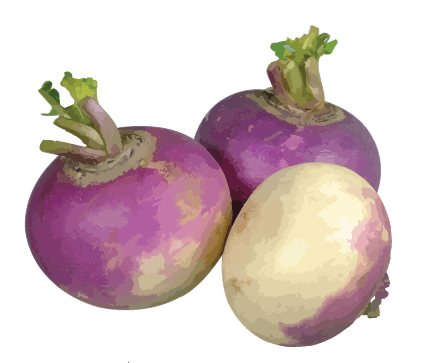
- Select pearly, heavy turnips with fresh leaves (if still attached) and without soft spots. Small to medium turnips are sweetest.
- Wash hands with warm water and soap for at least 20 seconds before and after handling fresh fruits and vegetables.
- Store turnips in the refrigerator in a perforated plastic bag for only a few days because they get bitter with prolonged storage.
Roasted Root Vegetables
Number of servings: 6
Ingredients:
Nonstick cooking spray
1 potato, cubed in 1-inch pieces
1 turnip, cubed in 1-inch pieces
1 sweet potato, cubed in 1-inch pieces
1 rutabaga, cubed in 1-inch pieces
2 carrots, cubed in 1-inch pieces
1 onion, coarsely chopped
1 tablespoon canola oil
1 teaspoon dried rosemary
1 teaspoon garlic powder
1 teaspoon dried sage
3 tablespoons Parmesan cheese
Directions:
- Heat oven to 350°F. Spray a baking sheet with nonstick spray.
- Rinse potatoes, turnip, rutabaga, and carrots, leaving skins on, and cube. As vegetables are cubed, add them to a large plastic food storage bag.
- Add chopped onion, oil, and seasonings to plastic bag.
- Seal plastic bag and shake well to distribute seasonings.
- Spread contents of bag in an even layer on baking sheet.
- Bake at 350°F for 1 hour or until tender. Sprinkle with Parmesan cheese before serving.
Per serving: 104 calories; 3 g fat (trace saturated fat); 3 g protein; 17 g carbohydrate; 3 g dietary fiber; 2 mg cholesterol; 78 mg sodium.
Turnips and Potatoes
Number of servings: 6
Ingredients:
2 vegetable bouillon cubes
2 cups water
6 turnips, peeled and cubed
1 cup onion, minced
4 cloves garlic, minced
3 tablespoons low-fat sour cream
Salt to taste
Ground black pepper to taste
4 ounces low-fat cheddar cheese, shredded
1 teaspoon dried parsley (optional)
Directions:
- In a saucepan over high heat, add the vegetable bouillon cubes and water, and bring to a boil. Cook until the bouillon cube dissolves, about 1 minute.
- Stir in the turnips, onion, and garlic, return to a boil, and cook the mixture until the turnips are tender, about 10 minutes.
- Reduce the heat to a simmer, and cook until most of the liquid has evaporated, about 10-15 more minutes.
- Lightly stir in the sour cream to coat the turnips. Sprinkle with salt and pepper to taste, and top with shredded Cheddar cheese and parsley, if desired.
Per serving: 68 calories; 2 g fat (1 g saturated fat); 5 g protein; 9 g carbohydrate; 2 g dietary fiber; 4 mg cholesterol; 316 mg sodium.
Quick Tips
- Use turnips any way you would use a potato. Try them baked or boiled in stews, soups, and stir-fries or lightly steamed.
- Remember that you may need to offer your child a new food 8-12 times before he or she is willing to try it, let alone like it.
- Clean turnips by rinsing under running tap water while rubbing with your hands or scrubbing with a clean brush.
- Enjoy shredded turnip instead of cabbage in your next batch of homemade coleslaw.
This institution is an equal opportunity provider. In accordance with Federal law and U.S. Department of Agriculture (USDA) civil rights regulations and policies, this institution is prohibited from discriminating on the basis of race, color, national origin, sex, age, disability, and reprisal or retaliation for prior civil rights activity. (Not all prohibited bases apply to all programs.) This material was partially funded by USDA’s Supplemental Nutrition Assistance Program – SNAP – and the Expanded Food and Nutrition Education Program (EFNEP). SNAP is funded by the U.S. Department of Agriculture Food and Nutrition Service and the Expanded Food and Nutrition Education Program (EFNEP) is funded by the U.S. Department of Agriculture, National Institute of Food and Agriculture (USDA/NIFA).
Virginia Cooperative Extension materials are available for public use, reprint, or citation without further permission, provided the use includes credit to the author and to Virginia Cooperative Extension, Virginia Tech, and Virginia State University.
Virginia Cooperative Extension is a partnership of Virginia Tech, Virginia State University, the U.S. Department of Agriculture (USDA), and local governments, and is an equal opportunity employer. For the full non-discrimination statement, please visit ext.vt.edu/accessibility.
Publication Date
February 8, 2021