Rose Chafer
ID
3104-1564 (ENTO-666NP)
Introduction
Rose chafer, Macrodactylus subspinosus (F.), is a scarab beetle (Coleoptera: Scarabaeidae).
Description
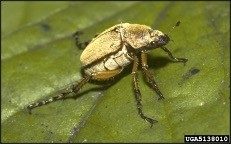
Adult rose chafers are yellow-tan beetles measuring up to 13 mm (0.5 inches) long (Fig. 1). They are covered with short yellow hairs that wear off with age, making the beetle appear darker in color. The underside of the body is also covered with short, light-colored hairs. Their legs are long, spiny, and colored reddish-brown to orange. The tip of the abdomen is blunt and not fully covered by the wings.

Rose chafer larvae, found in the soil, resemble other white grubs. They have a C-shaped body, brown legs, and a brown head capsule. Unlike other white grubs, rose chafer larvae are not usually considered a pest of lawns or turf.
Life History
Rose chafers have a complete life cycle of egg, larval, pupal, and adult stages. Rose chafer larvae overwinter in the soil. As soil temperatures rise in the spring, larvae move towards the soil surface and pupate in earthen cells. Adult beetles emerge in a few weeks and feed for about four to six weeks. Females deposit groups of 6-40 eggs about 15 cm (6 inches) below the soil surface in sandy or grassy areas. Larvae hatch in one to three weeks, depending on temperature, and begin to feed on the roots of grassy plants. One generation occurs annually in Virginia.
Common Host Plants
Adult rose chafers feed on a wide range of hosts, including blackberry, raspberry, strawberry, cabbage, beans, beets, grapes, and peppers. Ornamental hosts include roses, peonies, spirea, and often flowers with white or pale-colored petals. Sometimes rose chafers are found on the tender young foliage of elm, birch, and other trees.
Distribution
Rose chafers are native insects found throughout the eastern United States, west into Colorado.
Damage
Adult rose chafers damage plants by feeding on tender foliage, new buds, flowers, and fruits. The adults skeletonize leaves, leaving the major veins intact (Fig. 2). They also chew ragged holes in flower buds and soft fruits, and shred flower petals. The adults are active during the day, and mating pairs and clusters of beetles are often seen together on host plants.

If rose chafers have been a problem on your property in the past, watch for the adults in late spring and early summer. Adults are good fliers, and populations can arrive and build up unexpectedly.
Cultural Control
Handpick beetles when found and drop them into a bucket of soapy water to drown them. Do not feed these beetles to chickens or other birds, as the adults contain toxins.
Organic/Biological Control
A temporary cheesecloth fence slightly taller than the plant can deter the beetles. The beetles seem not to fly over the fence to land on the plant. Floating row covers are another option until the adult rose chafers go away.
Chemical Control
Start treatment with a registered insecticide when you see cut buds or leaf holes, usually just after the beginning of bloom in late March or early April. Treat at weekly intervals as needed. Rotate strawberries to a part of the garden that has not had strawberries in the last year.
See the current treatment recommendations for rose chafers in the Virginia Pest Management Guides for Home Grounds and Animals (VCE Publication 456-418) for homeowners or the Horticulture and Forest Crops (VCE Publication 456-418) for grapes and nursery crops. As with all pesticides, follow the label instructions carefully regarding rates and precautions.
Revised
Patricia L.S. Wooden, August 28, 2026.
Virginia Cooperative Extension materials are available for public use, reprint, or citation without further permission, provided the use includes credit to the author and to Virginia Cooperative Extension, Virginia Tech, and Virginia State University.
Virginia Cooperative Extension is a partnership of Virginia Tech, Virginia State University, the U.S. Department of Agriculture (USDA), and local governments, and is an equal opportunity employer. For the full non-discrimination statement, please visit ext.vt.edu/accessibility.
Publication Date
September 9, 2026