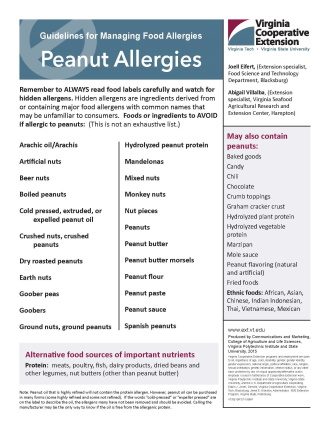
Guidelines for Managing Food Allergies: Peanut Allergies
ID
FST-198NP
Remember to ALWAYS read food labels carefully and watch for hidden allergens. Hidden allergens are ingredients derived from or containing major food allergens with common names that may be unfamiliar to consumers. Foods or ingredients to AVOID if allergic to peanuts: (This is not an exhaustive list.)
- Arachic oil/Arachis
- Artificial nuts
- Beer nuts
- Boiled peanuts
- Cold-pressed, extruded, or expelled peanut oil
- Crushed nuts, crushed peanuts
- Dry roasted peanuts
- Earth nuts
- Goober peas
- Goobers
- Ground nuts, ground peanuts
- Hydrolyzed peanut protein
- Mandelonas
- Mixed nuts
- Monkey nuts
- Nut pieces
- Peanuts
- Peanut butter
- Peanut butter morsels
- Peanut flour
- Peanut paste
- Peanut sauce
- Spanish peanuts
Alternative food sources of important nutrients
Protein: meats, poultry, fish, dairy products, dried beans and other legumes, nut butters (other than peanut butter)
May also contain peanuts:
- Baked goods
- Candy
- Chili
- Chocolate
- Crumb toppings
- Graham cracker crust
- Hydrolyzed plant protein
- Hydrolyzed vegetable protein
- Marzipan
- Mole sauce
- Peanut flavoring (natural and artificial)
- Fried foods
Ethnic foods: African, Asian, Chinese, Indian, Indonesian, Thai, Vietnamese, Mexican
Note: Peanut oil that is highly refined will not contain the protein allergen. However, peanut oil can be purchased in many forms (some highly refined and some not refined). If the words “cold-pressed” or “expeller pressed” are on the label to describe the oil, the allergens many have not been removed and should be avoided. Calling the manufacturer may be the only way to know if the oil is free from the allergenic protein.
Virginia Cooperative Extension materials are available for public use, reprint, or citation without further permission, provided the use includes credit to the author and to Virginia Cooperative Extension, Virginia Tech, and Virginia State University.
Virginia Cooperative Extension is a partnership of Virginia Tech, Virginia State University, the U.S. Department of Agriculture (USDA), and local governments, and is an equal opportunity employer. For the full non-discrimination statement, please visit ext.vt.edu/accessibility.
Publication Date
February 3, 2021