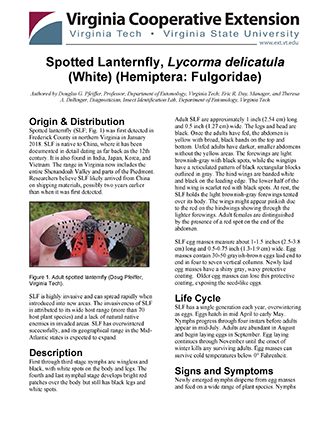
Spotted Lanternfly
ID
ENTO-180NP (ENTO-614NP)
-
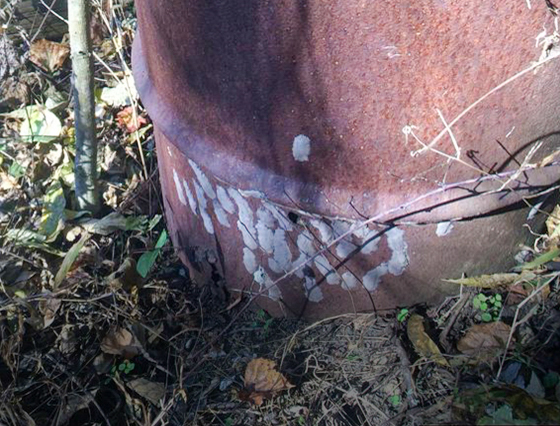
Spotted lanternfly egg masses on rusty metal drum. Image credit: Lawrence Barringer, Pennsylvania Department of Agriculture Bugwood.org.
-
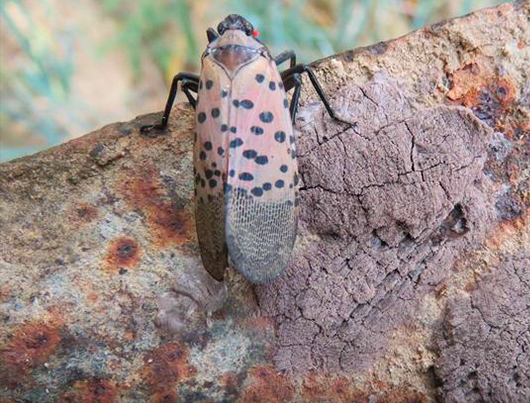
Spotted lanternfly adult and egg masses on a garden tool. Image credit: Kenneth R. Law, USDA APHIS PPQ, Bugwood.org.
-

Spotted lanternfly egg mass with weathered protective covering. Image credit: Kenneth R. Law, USDA APHIS PPO, Bugwood.org
-
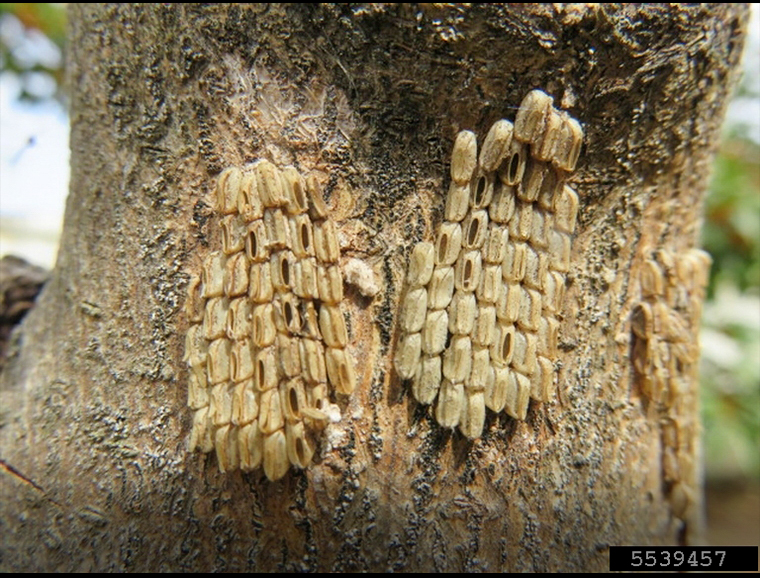
Spotted lanternfly eggs without protective covering. Image credit: Kenneth R. Law, USDA APHIS PPQ, Bugwood.org.
-

Fresh spotted lanternfly egg mass with waxy gray covering. Image credit: Pennsylvania Department of Agriculture, Bugwood.
-
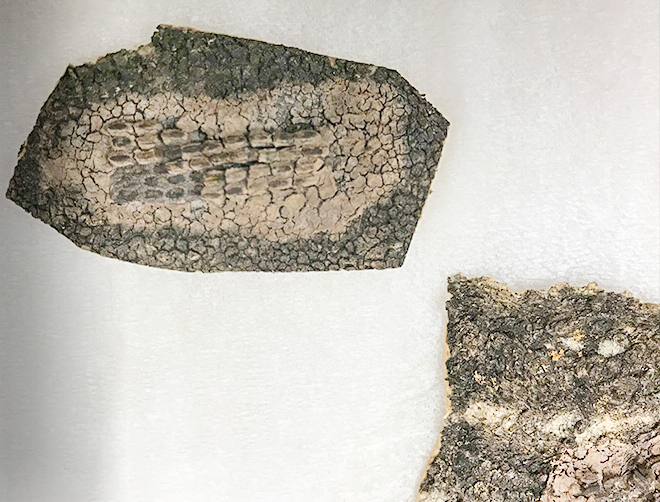
Difficult to spot egg masses of the spotted lanternfly. Image credit: Eric Day, Department of Entomology, Virginia Tech.
-
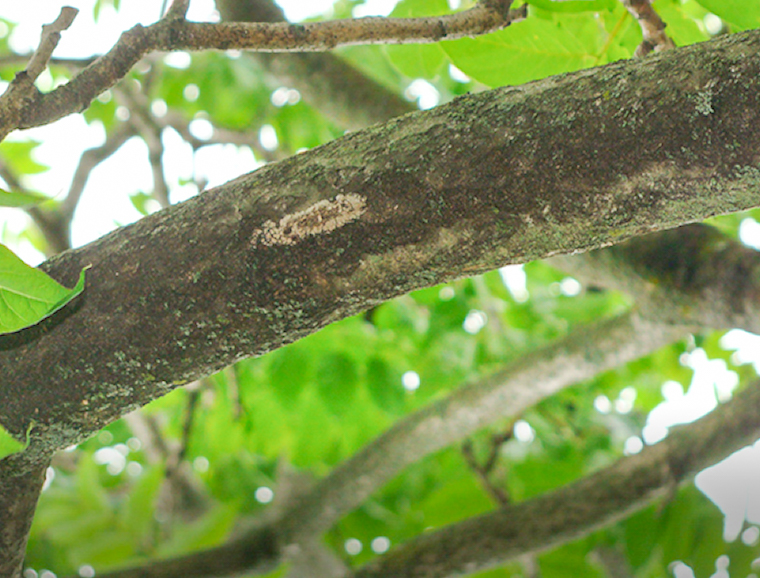
Spotted lanternfly egg mass on underside of branch. Image credit: Eric Day, Department of Entomology, Virginia Tech
-
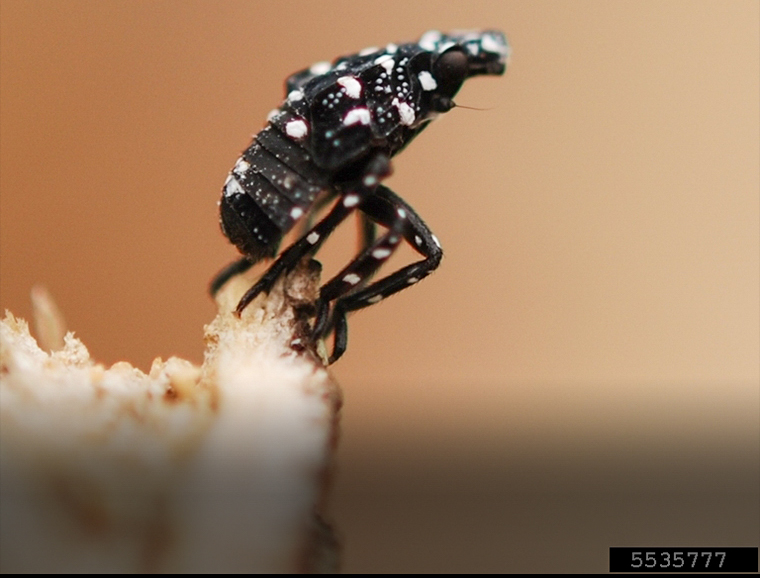
Black and white spotted lanternfly nymph. Image credit: Lawrence Barringer, Pennsylvania Department of Agriculture, Bugwood.org
-
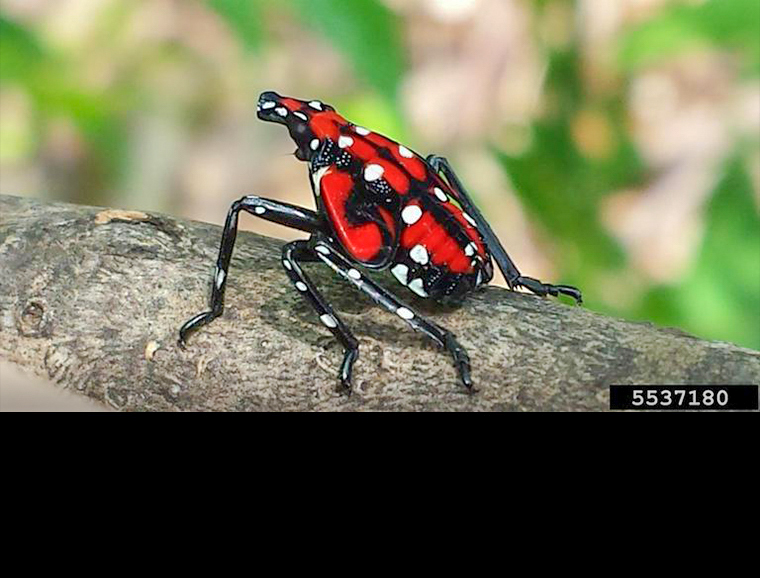
Fourth instar spotted lanternfly nymph. Image credit: Lawrence Barringer, Pennsylvania Department of Agriculture, Bugwood.org
-
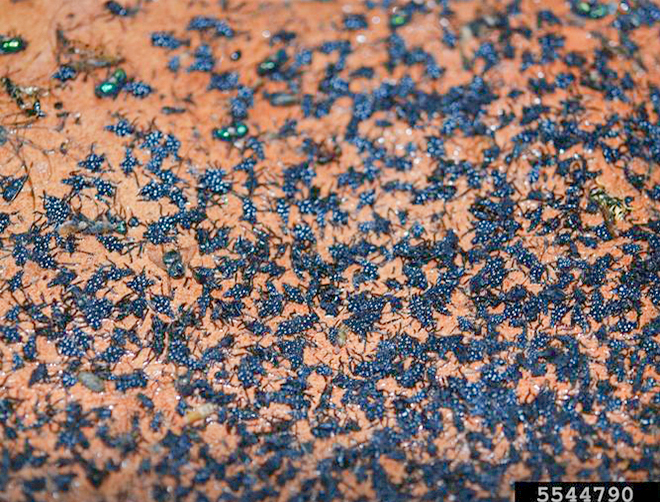
Numerous fourth instar spotted lanternfly nymphs trapped on sticky tree band. Image credit: Lawrence Barringer, Pennsylvania Department of Agriculture, Bugwood.org
-

Numerous fourth instar spotted lanternfly nymphs trapped on sticky tree band. Image credit: Lawrence Barringer, Pennsylvania Department of Agriculture, Bugwood.org
-
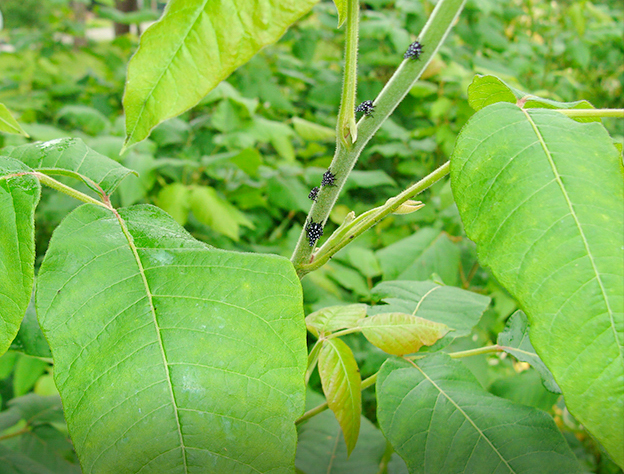
Cluster of spotted lanternfly nymphs. Image credit: Eric Day, Department of Entomology, Virginia Tech
-

Mature spotted lanternfly nymphs. Image credit: Eric Day, Department of Entomology, Virginia Tech
-
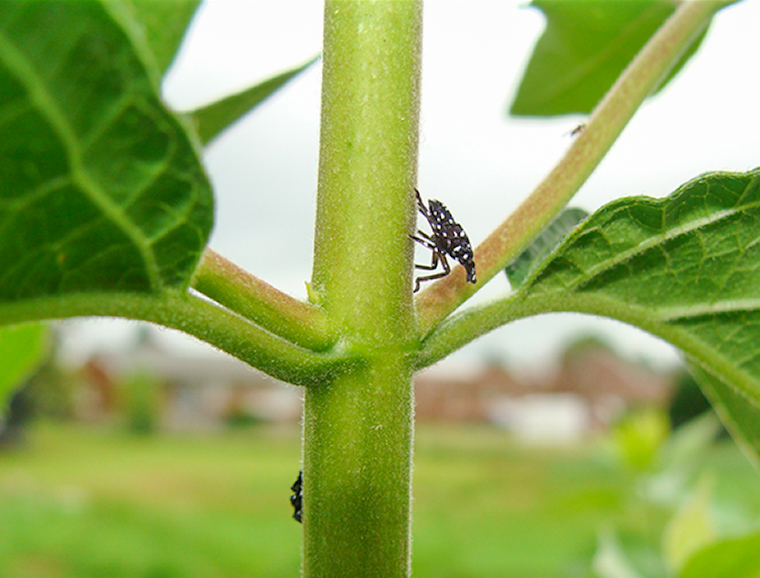
Spotted lanternfly nymph on stem. Image credit: Eric Day, Department of Entomology, Virginia Tech
-
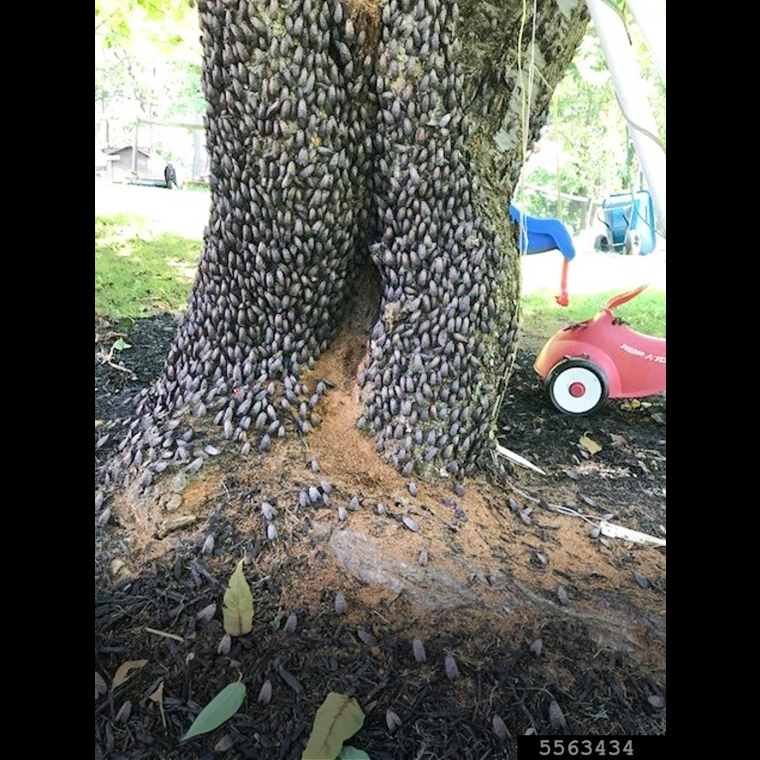
Tree trunk covered in adult spotted lanternflies. Image credit: Lawrence Barringer, Pennsylvania Department of Agriculture, Bugwood.org
-
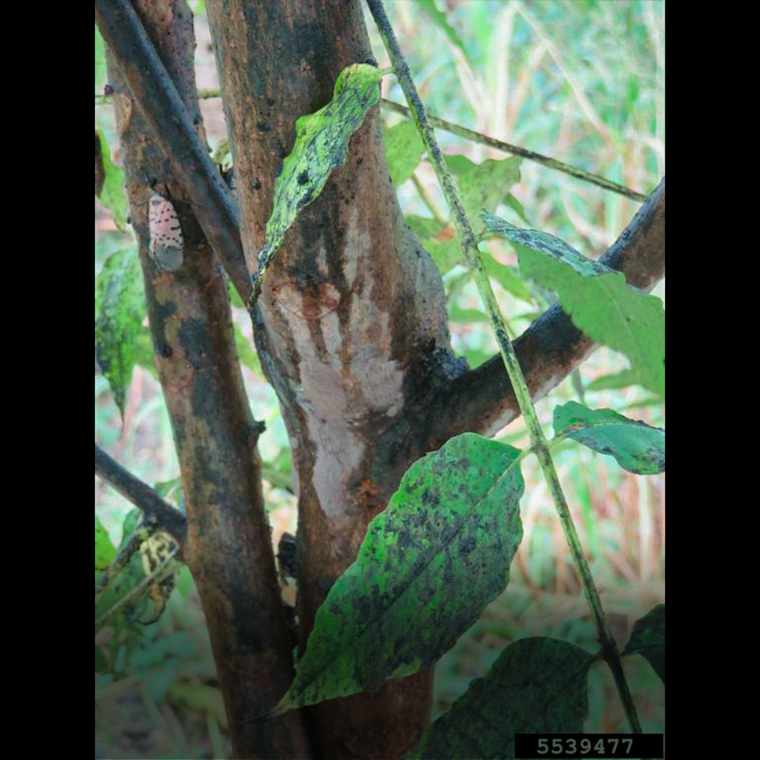
Infested tree covered with sap flow and honeydew produced by spotted lanternflies, with sooty mold growing on leaves. Image credit: Kenneth R. Law, USDA APHIS PPQ, Bugwood.org
-
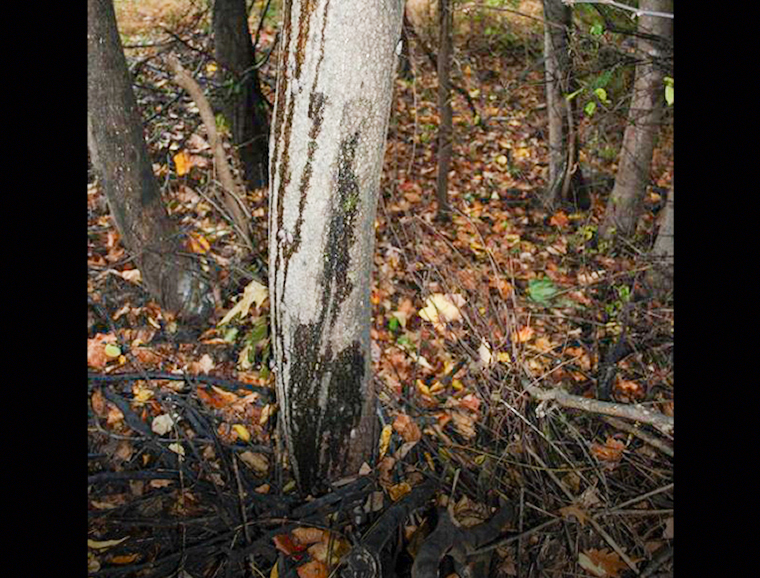
Tree-of-heaven trunk with weeping sap due to spotted lanternfly feeding. Image credit: Pennsylvania Department of Agriculture, Bugwood.
-
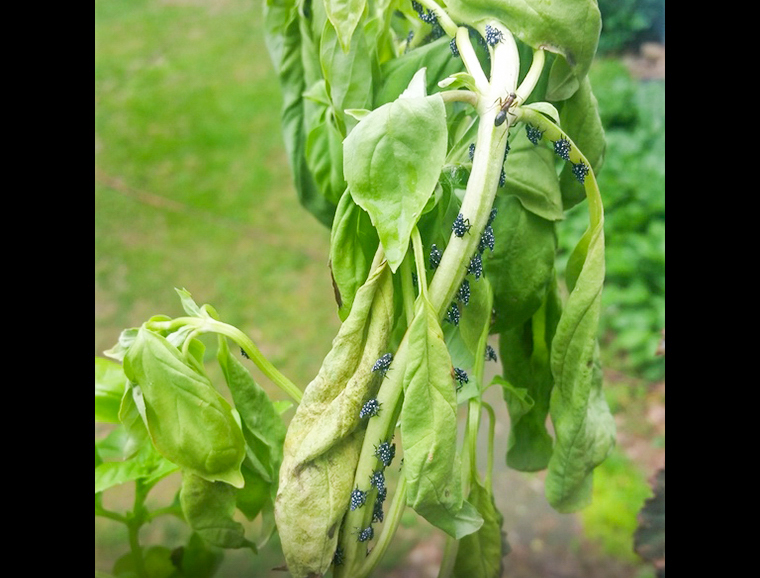
Wilting basil plant with spotted lanternfly nymphs on stem. Image credit: Lawrence Barringer, Pennsylvania Department of Agriculture, Bugwood.org
-
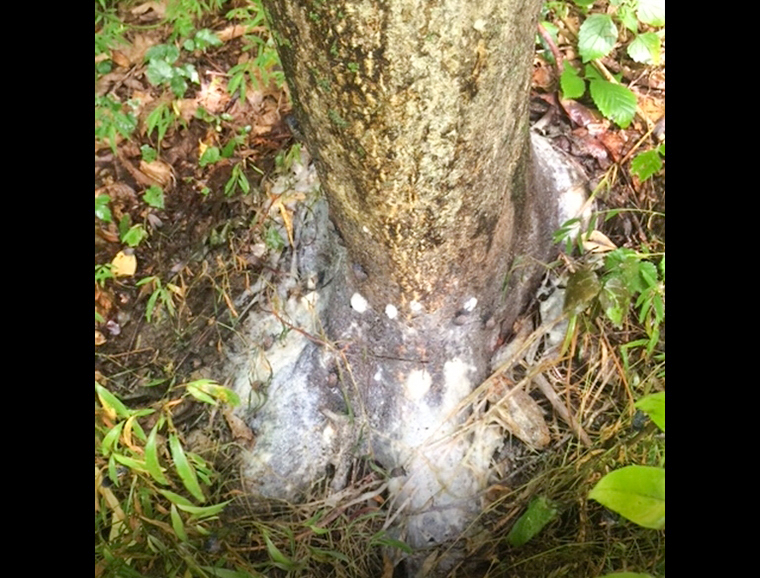
Base of tree covered with sooty mold and fungus growing on honeydew and sap flow produced by spotted lanternflies. Image credit: Lawrence Barringer, Pennsylvania Department of Agriculture, Bugwood.org
Origin & Distribution
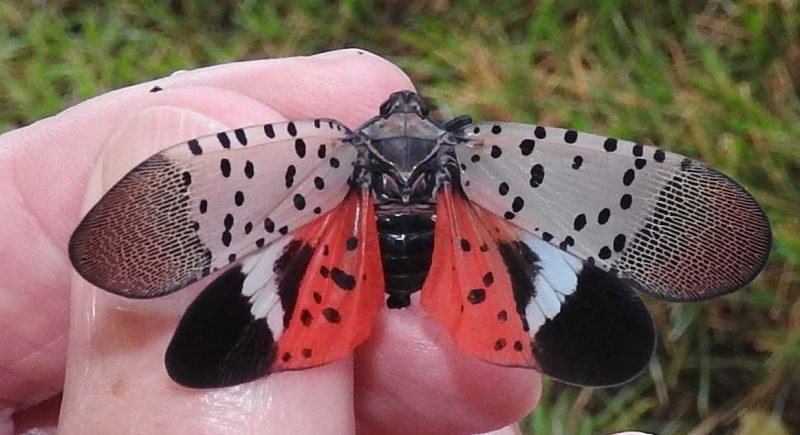
Spotted lanternfly (SLF; Figs. 1 & 2) was first detected in Virginia in 2018. SLF is native to China and is also found in India, Japan, Korea, and Vietnam. Researchers believe SLF likely arrived from Asia through commercial trade, possibly two years earlier than when it was first detected. SLF continues to spread through Virginia and the eastern U.S. It is highly invasive and can spread rapidly when introduced into new areas. The invasiveness of SLF is attributed to its wide host plant range and a lack of natural enemies in invaded areas.

Reporting SLF
There is no need to report spotted lanternfly in Virginia if you find it in a location already known to be infested. If your location isn’t marked on the map, please contact your local Virginia Cooperative Extension office to report your sighting of SLF.
Description
First through third stage nymphs are wingless and black, with white spots on the body and legs (Fig. 3). The fourth and last nymphal stage develops bright red patches over the body but still has black legs and white spots (Fig. 4).


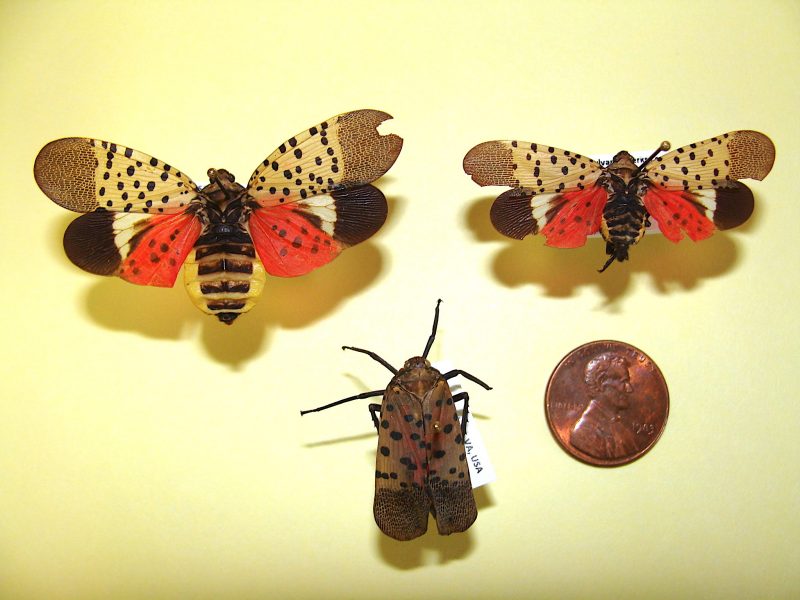
Adult SLF are approximately 1 inch (2.54 cm) long and 0.5 inch (1.27 cm) wide (Figs. 1 & 2). The legs and head are black. Unfed adults have small, dark abdomens. After feeding, the adult abdomen is yellow with broad, black bands. The forewings are light gray with black spots, while the wingtips have a reticulated pattern of black rectangular blocks outlined in gray (Figs. 1 & 2). The hind wings are banded white and black with black spots on a bright red patch (Fig. 1). At rest, adult SLF hold their forewings tented over the body (Fig. 2). The wings may appear pinkish due to the red on the hindwings showing through the lighter forewings.
SLF egg masses (Figs. 5 & 6) measure about 1-1.5 inches (2.5-3.8 cm) long and 0.5-0.75 inch (1.3-1.9 cm) wide. Newly laid egg masses have a shiny gray, waxy protective coating (Fig. 5). Older egg masses can lose this protective coating, exposing the seed-like eggs (Fig. 6). Egg masses contain 30-50 grayish-brown eggs laid end in four to seven vertical columns (Fig. 6).
Life Cycle
SLF has a single generation each year and overwinters in the egg masses. Eggs hatch in late April and early May. Nymphs progress through four instars before adults appear in July. Adults are abundant in August and begin laying eggs in September. Egg laying continues through November until the onset of cold temperatures kills any surviving adults. Egg masses can survive cold temperatures below 0°F.

Signs & Symptoms
Newly emerged nymphs disperse from egg masses and feed on a wide range of plant species. Nymphs are most often observed on leaves and branches of host plants. Look for nymphs on smaller plants and vines during the summer (Fig. 3). Nymphs are active and easily jump several feet to avoid capture.
Nymphs and adults typically gather in large numbers on host plants (Figs. 3 & 7). While they may become especially active at dusk or night as they migrate up and down the trunk of the plant, they are often conspicuous in midday as well. Adult SLF are found on tree trunks, stems, and sometimes near leaf litter at the tree base. Although winged, adults are better jumpers than flyers, and they prefer to move up trees by walking. Adults favor feeding on tree-of-heaven (TOH, Ailanthus altissima) and grapevine (Vitis vinifera). In the fall, adult SLF focus on TOH as a host for feeding and egg laying, although females will lay eggs on other trees (Fig. 5) or on any smooth vertical surface, natural or man-made.
Look for adults starting in mid-July. Mating and oviposition can be observed from evening to night from mid-September to November. Look for egg masses on tree trunks, fences, rocks, lawn furniture, storage sheds, and other smooth surfaces from October to early spring. Egg masses have been found on the lower side of large branches, many feet up the main trunk of a tree.

Look for adults starting in mid-July. Mating and oviposition can be observed from evening to night from mid-September to November. Look for egg masses on tree trunks, fences, rocks, lawn furniture, storage sheds, and other smooth surfaces from October to early spring. Egg masses have been found on the lower side of large branches many feet up the main trunk of a tree.
SLF is a phloem feeder, sucking sap from trunks, stems, and leaf petioles. Heavy feeding can cause wilting of leaves and young branches. Reduced photosynthesis due to SLF feeding weakens the plant and leads to branch dieback, thinning crowns, and, eventually, host plant mortality. Heavy feeding can also cause the plant to weep or ooze sap, which ferments and produces a disagreeable odor. Oozing sap will leave a wet, grayish-black trail down the trunk.
SLF excretes large volumes of honeydew, a sugar-rich fluid that covers plants and the ground underneath infested plants. Fresh honeydew often attracts other sugar-seeking insects such as yellow jackets, hornets, bees, ants, and flies. Honeydew supports the growth of sooty mold that covers leaves and blocks photosynthesis, weakening the plant and leading to its death. Blackened soil and even patches of yellowish-white mold can form at the base of an infested tree. Fermented honeydew has a sour, vinegary smell.
Blackened soil and even patches of yellowish-white mold can form at the base of an infested tree. Fresh honeydew often attracts other sugar-seeking insects such as yellow jackets, hornets, bees, ants, and flies. Fermented honeydew has a sour, vinegary smell.
Quarantine & Status
The Virginia Spotted Lanternfly Quarantine was repealed in March 2025. However, some states still maintain spotted lanternfly quarantines and require businesses shipping from Virginia to have a valid spotted lanternfly permit. Existing Virginia permits are no longer valid now that the quarantine was repealed, but valid permits can be obtained through Pennsylvania's Spotted Lanternfly Permit Training for Businesses Program. Contact the Plant Industry Services at the Virginia Department of Agriculture and Consumer Services (https://www.vdacs.virginia.gov/plant-industry-services-spotted-lanternfly.shtml) for more information.
Management of SLF
Removal and destruction of SLF egg masses and tree banding might reduce nymphal populations, but these methods are not likely to eradicate SLF. For chemical recommendations against SLF around the home, consult the current Pest Management Guide for Home Grounds and Animals.
Special precautions should be taken to avoid spreading SLF egg masses into other areas. Check any lawn furniture, grills, playground equipment, storage containers, and landscaping materials for egg masses before moving these items outside of infested areas. Remove and destroy any egg masses found.
Management of TOH is important to limiting populations of SLF, but it must be approached carefully because TOH will resprout heavily if it is simply mowed or cut down. Consult your local Virginia Cooperative Extension office for information on effective management options for removing TOH.
Virginia Cooperative Extension materials are available for public use, reprint, or citation without further permission, provided the use includes credit to the author and to Virginia Cooperative Extension, Virginia Tech, and Virginia State University.
Virginia Cooperative Extension is a partnership of Virginia Tech, Virginia State University, the U.S. Department of Agriculture (USDA), and local governments, and is an equal opportunity employer. For the full non-discrimination statement, please visit ext.vt.edu/accessibility.
Publication Date
August 21, 2025