What Is a Watershed?
ID
426-041 (SPES-2P)
A Watershed Defined
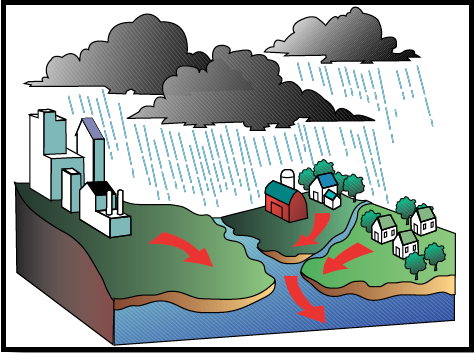
A watershed is an area of land that drains to a lake, river, wetland, or other waterway. When precipitation occurs, water travels over forest, agricultural, or urban/suburban land areas before entering a waterway. Water can also travel into underground aquifers on its way to larger bodies of water. Together, land and water make up a watershed system.
Watersheds can be any size, but generally, the larger the body of water the larger the watershed. For example, the Chesapeake Bay Watershed covers 64,000 square miles and drains from six states, including Virginia. Smaller, local watersheds drain much smaller areas. Even a local stream has a watershed associated with it, perhaps only a few acres in size.
There are nine major watersheds in Virginia. Some flow to the Chesapeake Bay. Some go directly into the Atlantic Ocean. Others flow to the Albemarle Sound in North Carolina. Some rivers in Virginia even flow to the Mississippi River and then to the Gulf of Mexico.
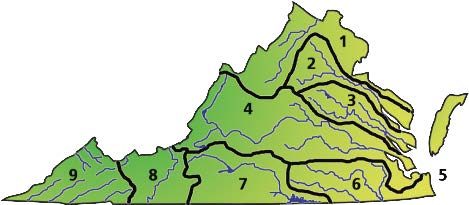
- Shenandoah-Potomac
- Rappahannock
- York
- James
- Eastern Shore of the Chesapeake Bay and coastal rivers
- Chowan
- Roanoke
- New
- Tennessee -Big Sandy
Why Are Watersheds Important?
Healthy watersheds are a vital component of a healthy environment. Watersheds provide many benefits including:
Clean water – The plants and soils of a watershed filter runoff that occurs from precipitation and snowmelt. Pollutants and sediment are removed so that water is cleaner for drinking, irrigation, recreation, industry, and commercial fishing.
Recreation and leisure activities – healthy watersheds with diverse vegetation and high quality water bodies provide many opportunities for outdoor activities like hiking, camping, boating, fishing, and swimming.
Habitat – Watersheds are important for supporting a wide variety of plant and wildlife communities.
Climate impacts – Watersheds with a high percent of healthy vegetation moderate temperatures, storm damage, flooding, and clean the air.
Scientists and community leaders recognize that the best way to protect our water resources is to understand and manage them on a watershed basis. Human activities as well as natural events that occur in a watershed can affect water quality throughout the entire system.
Human Impacts on Watersheds
Nearly all watersheds have something in common; they are populated by humans. With humans comes development and, unfortunately, pollution. As development encroaches on natural areas, vegetation is removed, soils are disturbed, and the filtering system of the watershed is replaced by impervious surfaces such as concrete and asphalt. Water runs off these surfaces in sheets, carrying with it a variety of pollutants. This type of pollution is called non-point source pollution because it comes from multiple sources over a large area. Anything on the impervious surface, such as automobile fluids, trash like plastic bottles and cigarette butts, leaves or grass clippings, debris, sediments, or animal feces is swept away by the run-off. It is carried directly into a waterway by storm drains and culverts. The more area covered in impervious surfaces, the higher amount of pollution and volume of runoff; which increases the liklihood of flooding, stream erosion, harm to wildlife and the environment, and degradation of water quality.
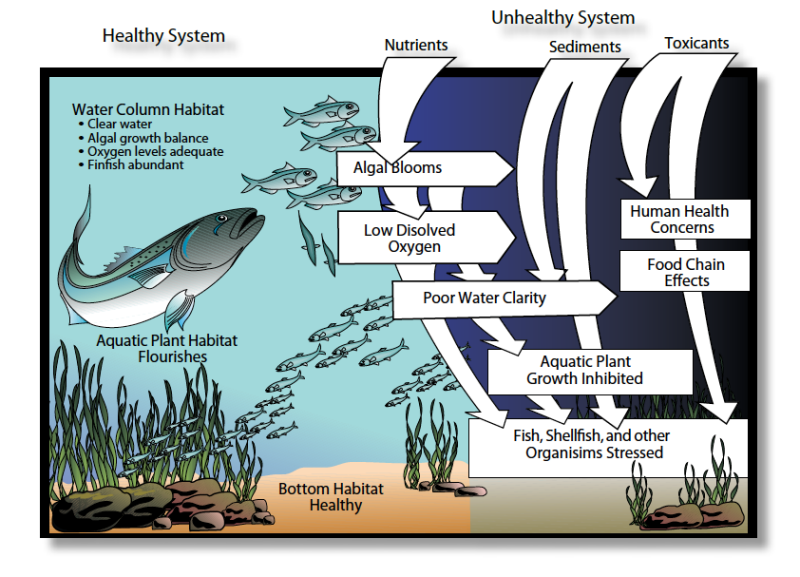
Fertilizer runoff from lawns and landscapes is another part of non-point source pollution. The overuse and incorrect use of fertilizers account for this type of pollution. The adage “if a little is good, then more is better” is not only false, but has serious detrimental effects on water quality. Excess fertilizer in the lawn or landscape is easily washed off by rain or irrigation. It travels into waterways, causing algal blooms that block sunlight, smother aquatic plants, and increase bacterial decay. As a result, dissolved oxygen is decreased and the water is unable to provide a healthy environment for aquatic life.
How can you help?
If everyone in Virginia would do a few simple things, we can greatly improve how our watersheds function in protecting water quality. Below are just a few ways you can help.
Reduce your daily water usage.
Never dispose of anything by dumping into a storm drain. Storm drains lead directly to waterways.
Use the correct amounts of fertilizer at the correct time of year for your grass species and landscape plants.
Reduce your use of pesticides and fertilizers by replacing grass with hardy trees, shrubs, and perennials.
Follow label directions carefully on all pesticides and use them only when necessary.
Clean up after your pets.
Maintain home septic systems.
Create buffers along waterways on your property.
Know your watershed address.
Volunteer for clean up, restoration, and conservation programs.
Promote sustainable land stewardship throughout your community.
Resources
Alliance for the Chesapeake Bay – http://www.allianceforthebay.org
Chesapeake Bay Program How-To’s and Tips -
https://www.chesapeakebay.net/action/howtotips
Chesapeake Conservation Landscaping Council Conservation Landscaping Guidelines -
www.ChesapeakeLandscape.org
Chesapeake Stormwater Network Homeowner BMP Guide -
http://chesapeakestormwater.net/2013/04/homeowner-bmp-guide/
Low Impact Development Center - https://lowimpactdevelopment.org/
Virginia Cooperative Extension Stormwater Management for Homeowners Fact Sheet series by L. Fox - http://pubs.ext.vt.edu/
Virginia Department of Forestry Rain Garden Technical Guide
http://www.dof.virginia.gov/infopubs/Rain-Garden-Technical-Guide-2014-05_pub.pdf
Virginia Cooperative Extension: publications on fertilizer and pesticide use, plant and grass selection and maintenance, and local Extension offices and agents - http://www.ext.vt.edu
Acknowledgements
The authors would like to express appreciation for the reviews and comments provided by the following individuals: Barry Fox, Extension Specialist, Virginia State University, Leanne Dubois, Extension Agent, James City, Peter Warren, Extension Agent, Albemarle County. This is a revised and updated version of the publication originally authored by Laurie Fox, Mike Andruczyk Traci Gilland, Susan French, and Lynnette Swanson.
Virginia Cooperative Extension materials are available for public use, reprint, or citation without further permission, provided the use includes credit to the author and to Virginia Cooperative Extension, Virginia Tech, and Virginia State University.
Virginia Cooperative Extension is a partnership of Virginia Tech, Virginia State University, the U.S. Department of Agriculture, and local governments. Its programs and employment are open to all, regardless of age, color, disability, sex (including pregnancy), gender, gender identity, gender expression, national origin, political affiliation, race, religion, sexual orientation, genetic information, military status, or any other basis protected by law
Publication Date
September 11, 2023