Raspberry Crown Borer
ID
3104-1561 (ENTO-473NP)
Introduction
Raspberry crown borer (Pennisetia marginata) belongs to the family Sesiidae in the order Lepidoptera. The larvae damage canes and crowns of raspberry, blackberry, and other species of Rubus.
Description
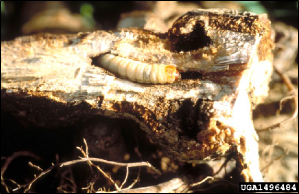
Raspberry crown borer larvae are stout, off-white to pinkish grub-like caterpillars with tan head capsules (Fig. 1). They measure 29-38 mm (1-1.5 inches) long when mature.
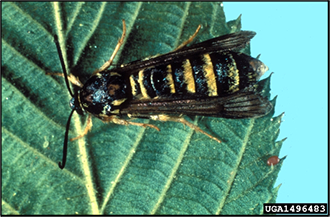
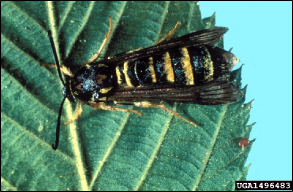
Adult raspberry crown borers are stout-bodied, furry moths with clear wings outlined in brown. They somewhat resemble a yellow jacket with a black body crossed by narrow yellow bands (Fig. 2). The body immediately behind the head can range from reddish-brown to black. The antennae are black but the furry legs are yellowish. The moths actively fly during the day.
The reddish-brown, oval eggs measure about 1.5 mm (0.06 inch) long. Individual eggs are laid along the leaf margin on the underside of leaves (Fig. 2).
Life Cycle
Raspberry crown borer has a complete life cycle of egg, larva, pupa, and adult stages occurring over a two-year period. Mated females lay their eggs on the lower edge of leaves on the host plant. The larvae hatch and move to the base of the plant near the soil line. They overwinter and resume tunneling in the canes and the crown the following spring. Older larvae hollow out the crowns of plants. Mature larvae emerge from the host plant through exit holes to pupate in summer. The cast pupal skins are sometimes found in their exit holes. The adult moths emerge in the fall, mate, and lay eggs. One generation of adults emerges each year.
Distribution
Raspberry crown borer is found throughout much of the eastern United States and along the Pacific coast.
Damage
Raspberry cane borer larvae tunnel through the crown and girdle the canes of blackberry, dewberry, and raspberry, along with any hybrids of these species of Rubus. They do not feed on the foliage or the fruits. Larval tunneling partially or completely girdles the canes. Affected canes may wither and collapse at the top into the shape of a shepherd’s hook. Affected canes may exhibit swellings at the base and may break easily. Affected crowns may appear swollen with conspicuous exit holes. Sawdust-like frass may be found at the base of cane tunnels and at exit holes.
Control
Remove and destroy infested canes and crowns in early spring or fall. Remove any wilted canes when seen during the summer. Whenever possible, remove wild blackberries or unmanaged brambles near the cultivated plants. In Virginia, wineberry (Rubus phoenicolasius) is a naturalized, invasive species that may support populations of raspberry crown borer.
For biological control, consider using a soil drench of Heterorhabditis bacteriophora (Hb) nematodes when soil temperatures are warm. These beneficial nematodes will attack raspberry crown borers but not harm the plant.
Use a registered insecticide to drench the crowns and the base of the canes between October and early April, before the young larvae become active. For current recommendations in commercial crops, see the Virginia Pest Management Guide for Horticultural and Forestry Crops (VCE 456-017). It may be necessary to treat the plants for several consecutive years as the raspberry crown borer is difficult to control given its protected location inside the plant and two-year life cycle.
Revised
Theresa A. Dellinger, November 22, 2021.
Virginia Cooperative Extension materials are available for public use, reprint, or citation without further permission, provided the use includes credit to the author and to Virginia Cooperative Extension, Virginia Tech, and Virginia State University.
Virginia Cooperative Extension is a partnership of Virginia Tech, Virginia State University, the U.S. Department of Agriculture (USDA), and local governments, and is an equal opportunity employer. For the full non-discrimination statement, please visit ext.vt.edu/accessibility.
Publication Date
December 22, 2021